How AI-Powered Virtual Try-On Technology Works
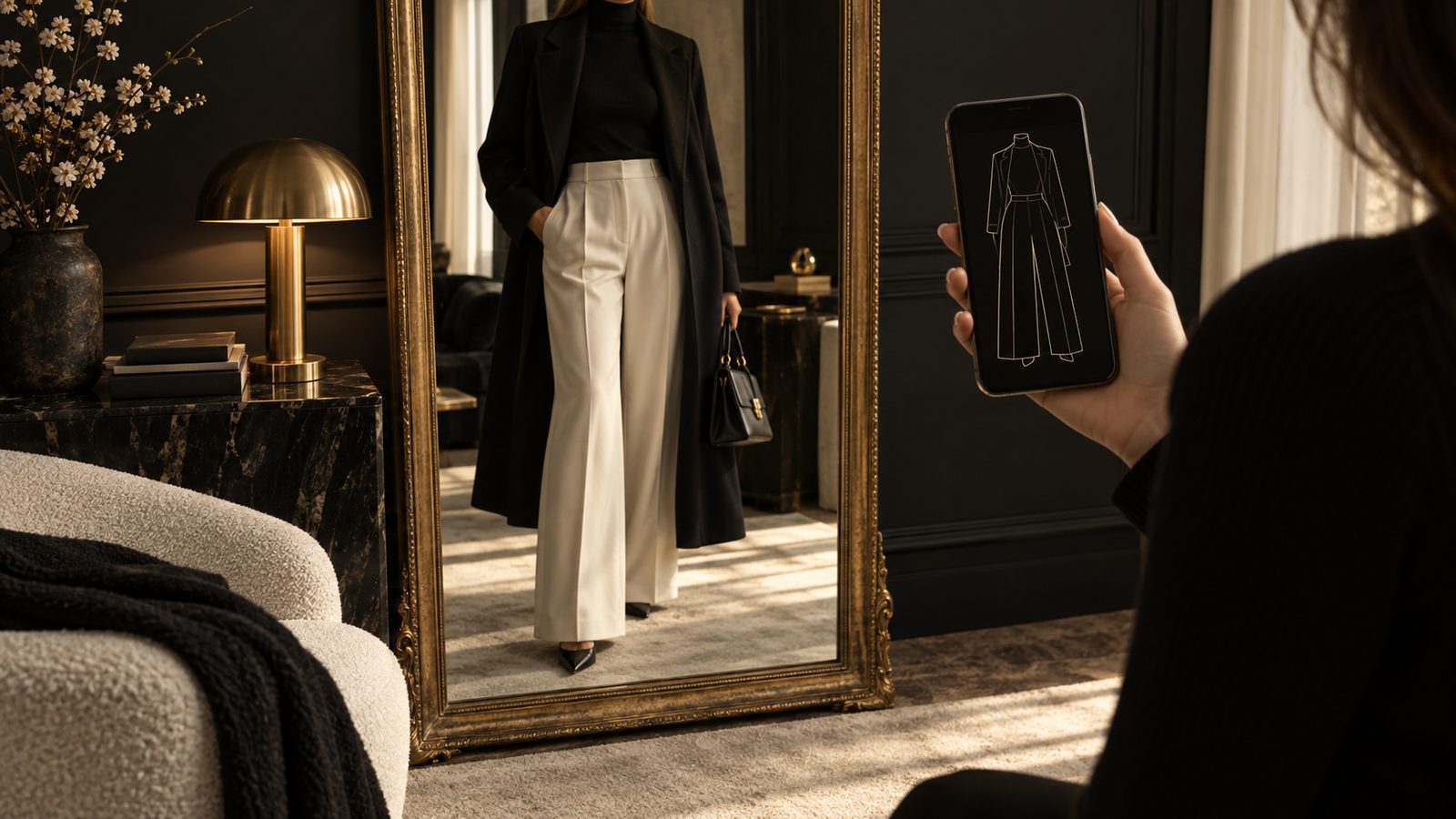
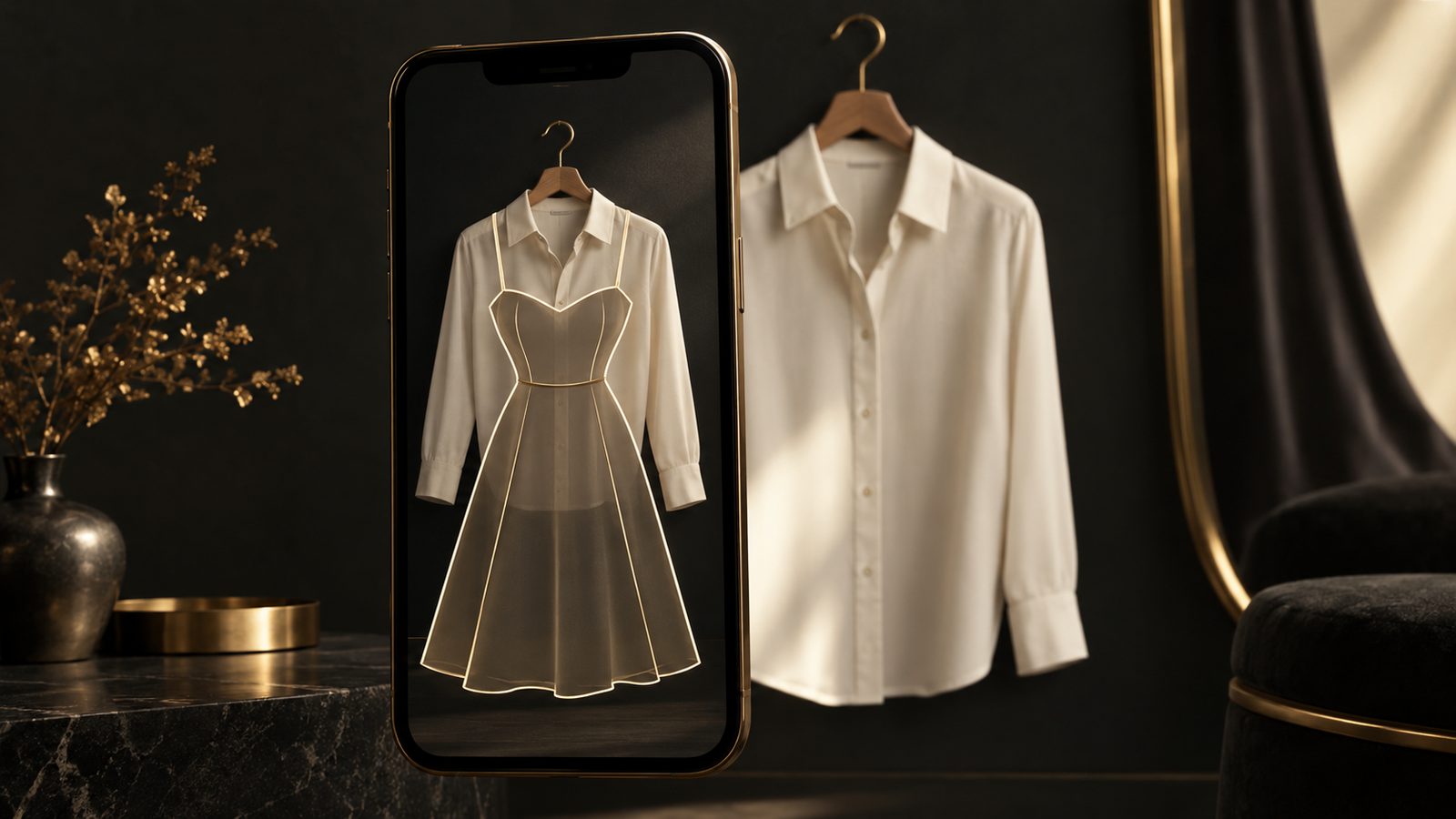
Virtual try-on shows how a garment might look on you or on a model without you wearing it.
Short answer
Virtual try-on shows how a garment might look on you or on a model without you wearing it. There are two main families:
- Overlay (AR) try-on, common for makeup, glasses and accessories. The system maps your face and draws the product on top.
- Generative try-on, used for clothes. A model generates a new image of a person wearing the garment, drawing folds and drape from scratch.
1. Overlay try-on (AR)
The law firm Mishcon de Reya describes how face try-on works in a March 2026 note: the technology detects facial features to build a digital mesh of facial geometry, sometimes called a faceprint, then overlays colours or product images. Some tools work on a still photo, others on live video. The same note says some tools also analyse images to recommend products, for example by skin tone or face shape.
Source: Mishcon de Reya, 13 Mar 2026.
2. Generative try-on for clothes
Clothes bend, fold and cling, so pasting a garment picture on a body looks wrong. Google's research team explained in June 2023 that older techniques like geometric warping "cut-and-paste and then deform" a clothing image and leave defects such as misplaced folds. Their alternative was to generate every pixel of the garment using a diffusion model.
Google describes diffusion like this: noise is gradually added to an image until it is unrecognisable, and then removed until the original is rebuilt. Text-to-image models use it with text. For try-on, Google uses a pair of images instead: one of a garment and one of a person. Each goes to its own neural network (a U-Net), and the two networks share information through "cross-attention" to produce a photo of the person wearing the garment. Google says it trained the model on pairs of images from its Shopping Graph.
The research paper is "TryOnDiffusion: A Tale of Two UNets" (arXiv 2306.08276) by authors at the University of Washington and Google Research. Its abstract says the goal is to generate a visualisation of how a garment might look on an input person, and that the main challenge is keeping garment detail while adapting the garment to large changes in body pose and shape. The authors describe a diffusion-based design that unifies two U-Nets, called Parallel-UNet. Figure 2 of the paper describes preprocessing steps: the person is segmented out of the photo to create a "clothing agnostic" image, the garment is segmented from its image, and pose is computed for both. Output is produced first at 128x128 pixels and then upscaled in further stages to 1024x1024.
Sources: Google blog, 14 Jun 2023; arXiv:2306.08276.
3. How it reached shoppers
- June 2023: Google launched try-on for women's tops from brands including H&M, Anthropologie, Everlane and Loft, on real models from XXS to 4XL (The Verge).
- September 2024: Google added dresses, shown on diverse models from XXS to XXXL, and described the technology as AI-powered diffusion that generates high-quality, realistic images (Google blog).
- June 2025: Google Labs released Doppl, an experimental app that creates a digital version of the user and shows outfits on them, including short videos. Google calls it "an early experiment" and says "fit, appearance and clothing details may not always be accurate."
Sources: The Verge, 14 Jun 2023; Google blog, 5 Sep 2024: https://blog.google/products-and-platforms/products/shopping/virtual-try-on-dresses/; Google blog, 26 Jun 2025.
4. What it can and cannot tell you
Good for: general look, colour, silhouette, how a style might sit on a body type similar to yours.
Not reliable for: exact fit and size. Google itself warns that fit and details may be inaccurate. Fabric stretch, true colour on your screen and seams are also hard to judge from a generated picture. Use size charts and return policies for fit.
5. Why generating the garment is hard
The paper's own summary of the problem is useful: earlier methods either preserved garment detail without handling big changes in pose and shape, or handled pose and shape but lost detail. Anyone who has seen a stripe or print stretch unnaturally in a bad edit will recognise this. It also explains why try-on results can look convincing yet still be wrong about real fit: the system is producing a plausible picture, not measuring how the fabric will behave on your body.
6. A step-by-step view of what happens when you try on a garment
- You supply a photo of yourself, or choose a model from the retailer's set.
- The system prepares the inputs. In the research system, the person is separated from the background and the clothing area is blanked out, the garment is cut out of its product image, and body pose is estimated for both images.
- The model generates the result. Both inputs feed networks that share information and produce a new image of the person wearing the garment.
- The image is refined. The paper describes stages that raise resolution step by step.
- You see the picture. Treat it as an illustration of style and drape, not a measurement.
This sequence describes the published research system. Commercial products such as Google's try-on or Doppl may differ in detail and Google has not published all of their internals.
Sources: arXiv:2306.08276; Google blog, 14 Jun 2023.
7. Questions to ask before you trust a try-on
- Does the retailer say the image is generated and may not show exact fit?
- Does it give a size chart and a return policy you can rely on?
- Does it tell you what it does with your photo?
8. Privacy: what happens to your photo?
Your photo is personal data. Mishcon notes that images and videos of a person are personal data and that try-on processing may involve biometric data, which gets extra protection under UK GDPR in some cases, though not every tool processes biometric data to identify a person. It adds that where consent is relied on it must be explicit and cannot be inferred from continued use. This applies in the UK; other countries differ (see our article on data privacy in fashion retail).
Practical habits for shoppers:
- Read what happens to your photo, how long it is kept, and whether it trains models.
- Use a photo you are comfortable sharing.
- Look for a way to delete your images.
Source: Mishcon de Reya, 13 Mar 2026.
9. What retailers should do
- Say plainly what is collected and why.
- Get explicit consent where the law requires it.
- Avoid using try-on images for profiling without a separate lawful basis.
- Be honest about accuracy.
What we do not know
- Whether try-on cuts returns. Retailers say it can, and Mishcon lists reduced returns as a benefit retailers hope for, but we found no independent figure to cite.
- Which brands use which vendor's tools today.
Sources
- Google blog, 14 Jun 2023: https://blog.google/products-and-platforms/products/shopping/virtual-try-on-google-generative-ai/
- arXiv:2306.08276: https://ar5iv.labs.arxiv.org/html/2306.08276
- The Verge, 14 Jun 2023: https://www.theverge.com/2023/6/14/23760504/google-shopping-ai-modeling-virtual-try-on-search-filters
- Google blog, 5 Sep 2024: https://blog.google/products-and-platforms/products/shopping/virtual-try-on-dresses/
- Google blog, 26 Jun 2025: https://blog.google/innovation-and-ai/models-and-research/google-labs/doppl/
- Mishcon de Reya, 13 Mar 2026: https://www.mishcon.com/news/virtual-try-on-data-protection-compliance-considerations
Editorial note
AI-assisted, source-linked editorial. No firsthand product or tool testing is claimed. Tutorials and prompts are illustrative workflows, not tested results.
- Paper figure details were read from the ar5iv HTML copy of the arXiv paper; check the arXiv original before quoting numbers.
- No firsthand testing of Doppl or Google try-on is claimed.
Source links
- https://ar5iv.labs.arxiv.org/html/2306.08276
- https://blog.google/innovation-and-ai/models-and-research/google-labs/doppl/
- https://blog.google/products-and-platforms/products/shopping/virtual-try-on-dresses/
- https://blog.google/products-and-platforms/products/shopping/virtual-try-on-google-generative-ai/
- https://www.mishcon.com/news/virtual-try-on-data-protection-compliance-considerations
- https://www.theverge.com/2023/6/14/23760504/google-shopping-ai-modeling-virtual-try-on-search-filters
Written by Pooja Ruhela, Founder & Editor · The Modera Society