How to Create Fashion Designs Using AI
AI image tools are best used for early concept work: exploring silhouettes, colours, prints and moods quickly.
Short answer
AI image tools are best used for early concept work: exploring silhouettes, colours, prints and moods quickly. They are not a replacement for pattern making, fabric knowledge or fit. Treat results as sketches to react to, and keep the human decisions that turn a picture into a garment.
This is a method guide. We have not run a design project for this draft, so the examples are templates, not reported results.
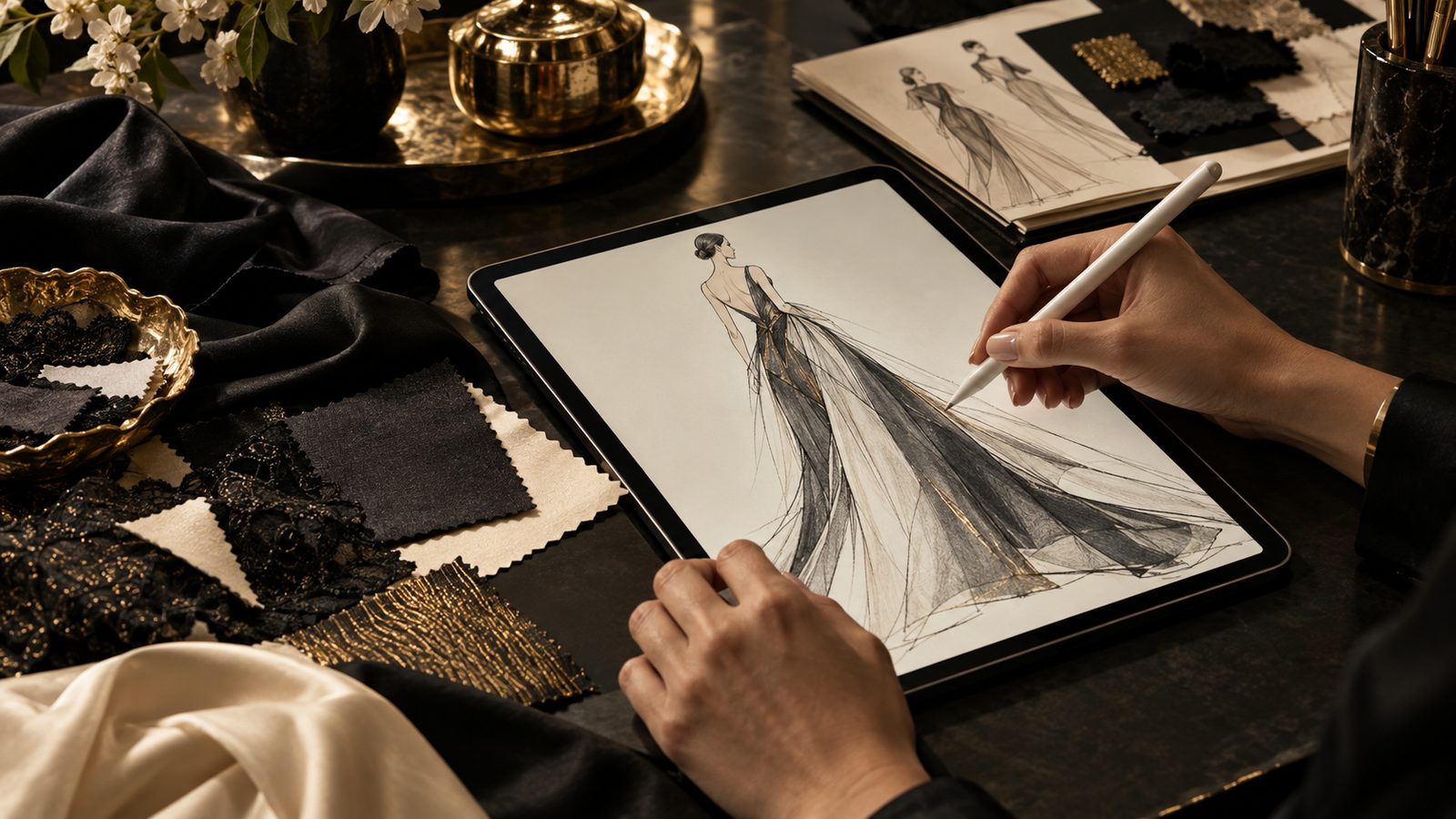
1. Start with a brief, not a prompt
Write five lines before opening any tool:
- Who is it for?
- What occasion or season?
- What fabrics and budget?
- What mood or references (your own sketches, museum archives, photographs you took)?
- What must it not be?
A clear brief keeps you from drifting into whatever the generator offers.
2. Generate concept options
Use an image generator to explore. Midjourney's documentation suggests describing subject, medium, environment, lighting, colour, mood and composition when details matter, and keeping prompts short and clear. For design exploration, adapt that:
Fashion illustration, front view, of a [garment type] in [fabric], [colour palette], [key detail such as sleeve or neckline], plain background
Change one thing at a time: neckline, then length, then print. Save every version with the prompt, so you can show your process later.
Source: Midjourney Docs, Prompt Basics.
3. Edit and combine, then redraw
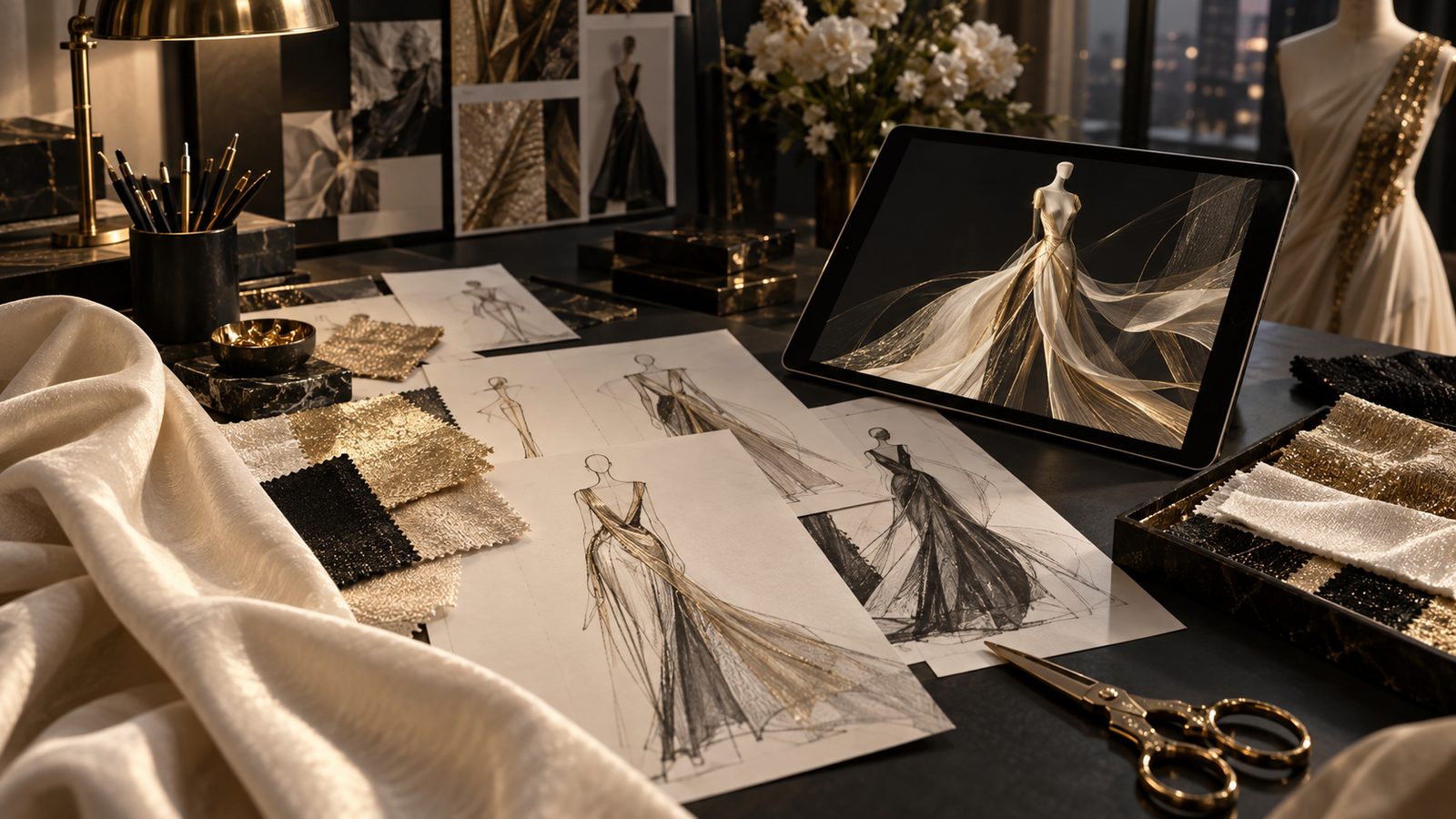
The most useful step is your own. Pick two or three directions. Sketch over them by hand or in drawing software. Combine details, simplify what cannot be sewn, and mark where seams, darts and closures go. A generated image will often show impossible construction: sleeves that attach nowhere, patterns that do not repeat, folds with no fabric logic.
4. Build a technical drawing and spec
Turn your chosen sketch into a flat (front and back drawing), then add measurements, fabric, trims and construction notes. This is the document a pattern maker or tailor will work from. AI can help you draft a spec template or a list of questions for your tailor, but check each measurement yourself.
5. Prototype
Make a toile (test version) in cheap fabric. Fit it, photograph it, and revise. Only now do you know whether the design works.
6. Keep your creative record (ownership)
The US Copyright Office concluded in January 2025 that generative AI outputs can be protected by copyright only where a human author determined sufficient expressive elements. It said that can include human arrangement or modification of AI output, but not the mere provision of prompts. That means your sketches, edits, selections and final technical drawings are the strongest evidence of authorship. Rules differ by country and this is not legal advice.
Source: U.S. Copyright Office / Library of Congress, 29 Jan 2025.
7. Responsible habits
- Do not copy living designers or brands. Do not prompt "in the style of" a named designer's current collections to produce lookalikes for sale.
- Check tool terms. Read the commercial-use terms of the tool you use.
- Disclose where needed. If you show AI imagery in advertising, check platform and local rules. EU transparency obligations for AI-generated content began applying on 2 August 2026.
- Credit collaborators. Pattern makers, tailors and illustrators did real work.
Education is moving this way too: the Fashion Institute of Technology in New York lists an AI-Assisted Design minor from fall 2026 whose learning outcomes include ethical and legal considerations such as copyright, authorship, data privacy and algorithmic bias, and combining AI-generated content with traditional design practice.
Source: FIT catalog, AI-Assisted Design minor.
8. Example workflow (template)
| Step | What you do | What AI does | What you keep |
|---|---|---|---|
| Brief | Write five lines | Optional: suggest questions | Your brief |
| Explore | Choose directions | Generate concept images | Prompt log |
| Refine | Sketch over, simplify | Nothing | Your sketches |
| Spec | Draw flats, measure | Optional: template | Technical pack |
| Prototype | Sew, fit, revise | Nothing | Photos, notes |
9. Using parameters for design exploration (Midjourney as one example)
Midjourney's Parameter List says images start as squares and the --ar parameter changes the shape, --seed helps testing and experimenting, --no tells the tool what you do not want, and --tile creates seamless repeating patterns. For a designer, --tile is worth trying for print and textile ideas, and --seed helps you compare one change at a time. Its Style Reference page says a style reference captures colours, medium, textures or lighting from an existing image without copying objects or people, so you can feed it your own approved sketch or swatch photo to keep a series visually consistent. Version support and defaults change, so check the current pages. We read the descriptions on 24 Nov 2026 and did not run the parameters.
Sources: Midjourney Parameter List; Midjourney Style Reference.
10. A design brief template you can copy
| Field | Example question |
|---|---|
| Customer | Who wears it, and where? |
| Season and occasion | Monsoon office wear? Wedding guest? |
| Fabric | What can you actually source, and at what cost? |
| Silhouette | Fitted, straight, A-line, oversized? |
| Details | Neckline, sleeve, closure, pockets |
| Palette | Three to five colours |
| Solid, block print, embroidery | |
| Production | Who sews it, what is the minimum order? |
| Constraints | Budget, timeline, sizes |
| Not this | Anything you want to avoid, including copying existing designs |
Fill this in before you generate anything. It becomes the filter for choosing between AI options.
11. From a picture to a pattern: what AI skips
An image shows one view of a garment. It does not give you grain lines, seam allowances, ease, notches or a size range. Those come from pattern making and grading, which still need a person with those skills. Plan time and cost for this step. If your concept needs unusual fabric behaviour, such as heavy drape in a stiff cotton, test fabric early. This is general design practice rather than a claim from a particular source.
12. Authorship in practice
The Copyright Office's January 2025 report says copyright can protect a human-authored work that is perceptible in an AI output, and creative arrangements or modifications of the output, but not the mere provision of prompts. A practical record for a design might therefore include: your original brief and sketches, the generated options you rejected, the sketches you drew over your chosen option, the final flat drawings and measurements, and photographs of the toile and finished garment. Whether any particular design is protectable depends on the facts and the country, so take legal advice before relying on this for a collection you plan to sell.
Source: U.S. Copyright Office / Library of Congress, 29 Jan 2025.
What we do not know
- Which tools suit which garment types best. We did not compare them.
Sources
Midjourney, Prompt Basics: https://docs.midjourney.com/hc/en-us/articles/32023408776205-Prompt-Basics
U.S. Copyright Office, 29 Jan 2025: https://newsroom.loc.gov/news/copyright-office-releases-part-2-of-artificial-intelligence-report/s/f3959c36-d616-498d-b8f9-67641fd18bab
FIT AI-Assisted Design minor: https://catalog.fitnyc.edu/undergraduate/minors/art-design/ai-assisted-design/
European Commission, 31 Jul 2026: https://digital-strategy.ec.europa.eu/en/news/commission-starts-enforcing-ai-act-rules-and-new-transparency-requirements-2-august
Midjourney, Parameter List and Style Reference (read 24 Nov 2026): https://docs.midjourney.com/hc/en-us/articles/32859204029709-Parameter-List and https://docs.midjourney.com/hc/en-us/articles/32180011136653-Style-Reference
Editorial note
AI-assisted, source-linked editorial. No firsthand product or tool testing is claimed. Tutorials and prompts are illustrative workflows, not tested results.
- Example workflow is a template, not a reported project. Pattern-making comments in section 11 are general practice, not sourced.
Source links
- https://catalog.fitnyc.edu/undergraduate/minors/art-design/ai-assisted-design/
- https://digital-strategy.ec.europa.eu/en/news/commission-starts-enforcing-ai-act-rules-and-new-transparency-requirements-2-august
- https://docs.midjourney.com/hc/en-us/articles/32023408776205-Prompt-Basics
- https://docs.midjourney.com/hc/en-us/articles/32180011136653-Style-Reference
- https://docs.midjourney.com/hc/en-us/articles/32859204029709-Parameter-List
- https://newsroom.loc.gov/news/copyright-office-releases-part-2-of-artificial-intelligence-report/s/f3959c36-d616-498d-b8f9-67641fd18bab
Written by Pooja Ruhela, Founder & Editor · The Modera Society