How to Write Better AI Prompts for Fashion Photography
A good fashion prompt names the subject, the look of the photograph, the light, the setting and the framing, and says what matters most.
Short answer
A good fashion prompt names the subject, the look of the photograph, the light, the setting and the framing, and says what matters most. Tools differ, so follow your tool's own documentation. Midjourney's Prompt Basics page gives a clear model and we use it here as the reference. Other generators (including ChatGPT's image tools) respond to the same ideas but have their own rules.
1. The building blocks
Midjourney's documentation lists areas to consider when details matter:
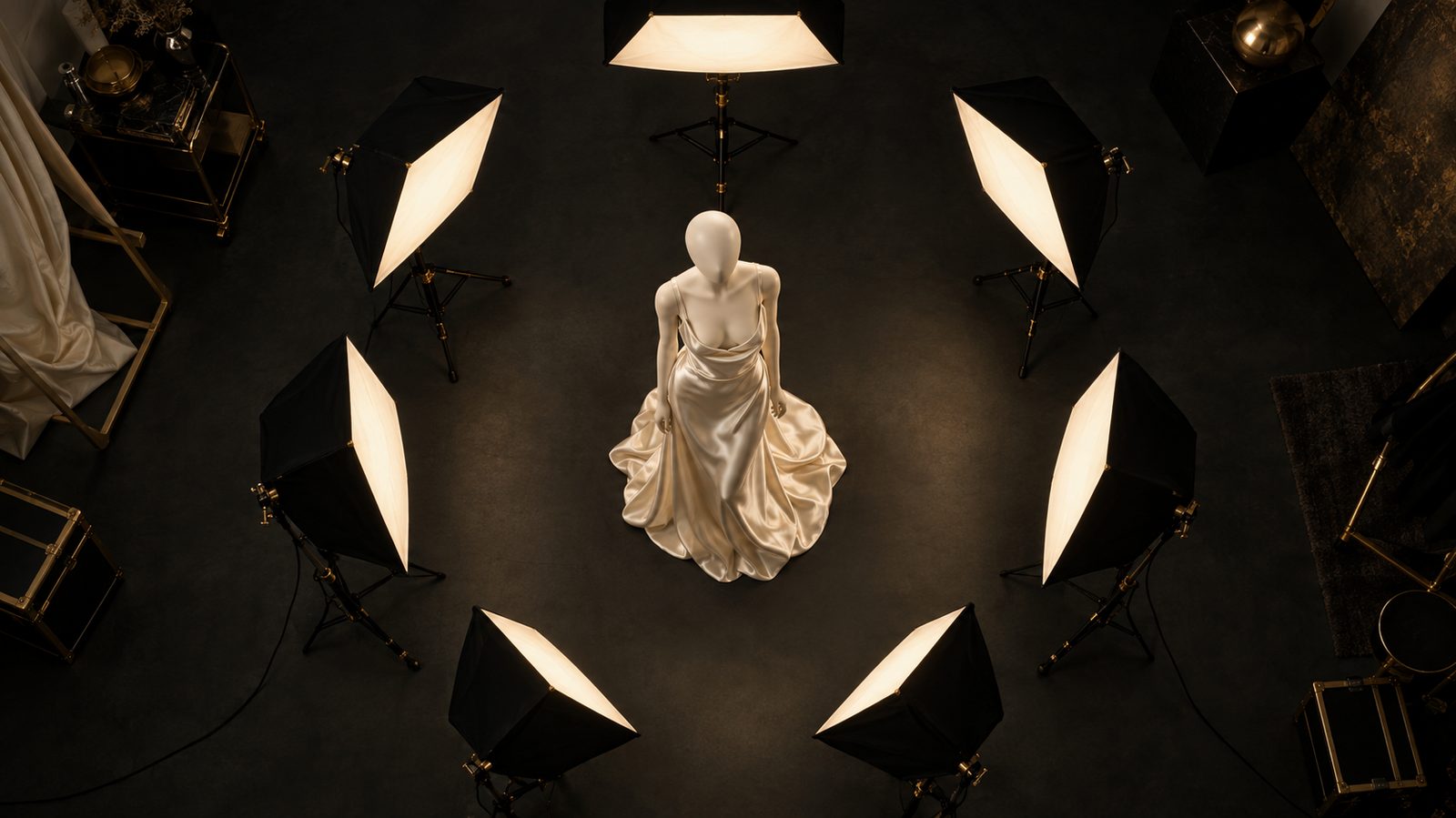
- Subject: who or what (person, object, location)
- Medium: photo, painting, illustration
- Environment: indoors, outdoors, city
- Lighting: soft, ambient, overcast, neon, studio lights
- Color: vibrant, muted, monochromatic, pastel
- Mood: playful, calm, energetic
- Composition: portrait, headshot, closeup, birds-eye view
For fashion we add two of our own: garment details (cut, fabric, colour) and styling (shoes, jewellery, hair). These are our suggestions, not Midjourney's.
Source: Midjourney Docs, Prompt Basics.
2. Keep it short and clear
Midjourney says short, simple prompts typically give the best images, and long lists of instructions can confuse the process. Its example: instead of a long request sentence, write "Colored pencil illustration of bright orange California poppies." Fewer details give more variety and less control, so include the details that matter and leave the rest.
3. Say what you want, not what you do not want
Midjourney advises describing what you do want. Mentioning "no cake" may still produce a cake. For exclusions, it points to its dedicated "no" parameter. Other tools may differ.
4. Be specific with words and numbers
Midjourney suggests precise words ("huge" or "enormous" rather than "big") and specific numbers ("three cats" rather than "cats"). In fashion: "a camel wool coat" is better than "a nice coat"; "one model" is better than "people".
5. A prompt formula you can reuse
Fill the slots in this order:
[Medium + framing] of [subject] wearing [garment details], [setting], [lighting], [mood], [colour palette]
Examples (templates to adapt, not tested results):
- Editorial photograph, full length, of a woman wearing a deep green silk saree with a gold border, courtyard with arches, soft morning light, calm mood, warm neutral palette.
- Studio product photo, flat lay, of a navy linen shirt and tan loafers, plain light grey background, soft even studio lighting.
- Black and white portrait, close-up, of a model in a structured wool blazer, hard side light, confident mood.
6. Iterate one change at a time
Change one slot per attempt: lighting first, then setting, then framing. Keep notes on which wording moved the result. This is how you learn what your tool responds to, and it gives you a record of your own creative choices.
7. Parameters and references
Midjourney lets you add parameters and image or style references to steer results. Its documentation says parameters always go at the end of the prompt, after the description, with a space before the dashes and no punctuation inside the parameter. Parameters listed there that matter for fashion work include:
--ar(or--aspect): aspect ratio. Images start square, so set a tall ratio for a full-length look or a wide one for a banner.--no: tells the tool what you do not want in the image.--seed: for testing and experimenting, so you can compare changes.--stylizeand--raw: control how much artistic flair the tool adds versus how literally it follows your words.--tile: creates seamless repeating patterns, which is useful for prints and textile ideas.--srefand--sw: a style reference and its strength.
Midjourney's Style Reference page says a style reference captures the visual vibe of an existing image, such as colours, medium, textures or lighting, and applies it to new creations. It says it does not copy objects or people. It is compatible with Midjourney version 6 and later, and --sw accepts values from 0 to 1000 with a default of 100. Its best-practice advice is to keep text prompts simple, describe what you want to see rather than how to modify the reference, and avoid style words that conflict with the reference. A good prompt example from the page is a plain description of the subject, not an instruction such as "copy this style."
These settings and defaults are version-specific and change often. Check the current Parameter List before relying on any of them. We read the pages on 24 Nov 2026 but have not run the parameters ourselves.
Sources: Midjourney Parameter List and Style Reference pages.
8. Fashion-specific cautions
- Hands, fabric and text. Check fingers, seams, patterns and logos. Retouch or regenerate.
- Real people and brands. Do not prompt for a real person's likeness or a brand's logo unless you have permission. OpenAI's usage policies are the place to check what its tools allow.
- Ownership. The US Copyright Office says AI outputs can be protected only where a human determined sufficient expressive elements, and that prompts alone are not enough. Keep your edits and selections.
- Disclosure. If you publish AI images in ads, say so where rules or platform policy require it. EU transparency rules for AI-generated content began applying on 2 August 2026.
9. Worked example: one idea, five revisions
This is a method illustration, not a record of a real session. Say the goal is a calm editorial image for a linen shirt.
- Start: Editorial photograph of a model wearing an ivory linen shirt, soft window light, calm mood --ar 4:5
- Revision 1, setting: add plain plaster wall, terracotta pot.
- Revision 2, framing: change to waist-up, slightly low angle.
- Revision 3, colour: add muted earth palette.
- Revision 4, exclusion: add
--nofollowed by the elements you do not want, such as text or extra people. - Revision 5, consistency: add a style reference of your own previous approved image and keep the prompt simple.
Keep the prompt log. If you later need to show how an image was made, the log shows your choices at each step.
10. Common mistakes
- Too many instructions. Midjourney warns long lists can confuse the process.
- Negative phrasing. Say what you want. Use the exclusion parameter for what you do not.
- Vague nouns. "Dress" gives variety you did not ask for. "Knee-length cotton wrap dress" does not.
- Changing everything at once. You cannot tell which change helped.
- Skipping the real product. For selling real clothing, a generated garment is not evidence of the product.
11. A quick checklist
- Subject and garment clear?
- Medium and framing set?
- Light and mood named?
- Short enough to read in one breath?
- Positive wording only?
- Checked for errors?
- Disclosure decided?
What we do not know
- Which tool gives the best fashion results. We did not run comparisons.
Sources
Midjourney, Prompt Basics: https://docs.midjourney.com/hc/en-us/articles/32023408776205-Prompt-Basics
Midjourney, Parameter List: https://docs.midjourney.com/hc/en-us/articles/32859204029709-Parameter-List
Midjourney, Style Reference: https://docs.midjourney.com/hc/en-us/articles/32180011136653-Style-Reference
OpenAI usage policies: https://openai.com/policies/usage-policies/
U.S. Copyright Office, 29 Jan 2025: https://newsroom.loc.gov/news/copyright-office-releases-part-2-of-artificial-intelligence-report/s/f3959c36-d616-498d-b8f9-67641fd18bab
European Commission, 31 Jul 2026: https://digital-strategy.ec.europa.eu/en/news/commission-starts-enforcing-ai-act-rules-and-new-transparency-requirements-2-august
Midjourney, Parameter List (read 24 Nov 2026) and Style Reference (read 24 Nov 2026), linked above.
Editorial note
AI-assisted, source-linked editorial. No firsthand product or tool testing is claimed. Tutorials and prompts are illustrative workflows, not tested results.
- Parameter and Style Reference pages were read on 24 Nov 2026 (descriptions only); parameters not run by us. Midjourney version numbers change often.
- Example prompts are untested templates.
Source links
- https://digital-strategy.ec.europa.eu/en/news/commission-starts-enforcing-ai-act-rules-and-new-transparency-requirements-2-august
- https://docs.midjourney.com/hc/en-us/articles/32023408776205-Prompt-Basics
- https://docs.midjourney.com/hc/en-us/articles/32180011136653-Style-Reference
- https://docs.midjourney.com/hc/en-us/articles/32859204029709-Parameter-List
- https://newsroom.loc.gov/news/copyright-office-releases-part-2-of-artificial-intelligence-report/s/f3959c36-d616-498d-b8f9-67641fd18bab
- https://openai.com/policies/usage-policies/
Written by Pooja Ruhela, Founder & Editor · The Modera Society